

Skip to content
Jeff-Website-photo-new

Jeffrey B. Baird

Partner

Jeff Baird brings nearly three decades of exclusive construction law experience to his clients. Highly fluent in the economics of project operations, Jeff is a seasoned litigator and project counselor, with significant pre-litigation construction claim experience. He is prepared to handle significant construction litigation while always watching for an opportunity to resolve matters early to mitigate financial exposure. Jeff now offers mediation services focusing on Civil Code 8850 and Public Contract Code 9204 mediations.

Attorneys

(858) 737-3100; Ext. 3036

(858) 737-3101

For nearly three decades, Jeff Baird has built a career defined by a singular, relentless focus on providing exceptional legal representation to clients in the construction industry. He is not a generalist who dabbles in construction mattersHe is a dedicated construction litigator whose professional life is devoted to mastering the legal, commercial, and operational complexities of construction projects. This depth of focus allows Jeff to understand his clients not merely as litigants, but as businesses with schedules to meet, margins to protect, and reputations to defend.

Jeff has extensive experience with the way construction companies actually operate, from the field-level realities of performance and scheduling to the executive-level concerns of cash flow, risk allocation, and cost containment. He understands industry practices, the pressures of the bid environment, and the financial consequences that flow from every default, change order, and payment dispute. Jeff’s fluency in the language and economics of construction makes him a formidable advocate and a trusted counselor, equally effective whether he is dismantling an opponent’s claim or guiding a client through a high-stakes project decision in real time.

While Jeff is a seasoned and aggressive litigator who is fully prepared to take any matter to trial, arbitration, or appeal, his governing philosophy is to resolve claims early, decisively, and efficiently. He specializes in early claim resolution designed to mitigate legal cost and preserve client capital, recognizing that the most powerful outcome is often the one achieved before a dispute consumes a project’s profitability. To that end, Jeff routinely counsels construction clients on course-of-construction issues as they arise during active projects, intervening before problems harden into claims, lawsuits, or losses. This forward-looking, risk-avoidance approach has made him a uniquely valuable partner to contractors, subcontractors, owners, and sureties who demand both legal sophistication and commercial pragmatism. 

Jeff has appeared in the mediation of hundreds of construction claims and lawsuits, and litigated disputes across the full spectrum of public and private works. He is also a recognized thought leader who has authored articles and presented on a wide range of construction topics, sharing his command of the law with peers and clients alike. 

Jeff also serves as a mediator for construction matters focused on California Civil Code Section 8850 mediations.   

Construction Contracts and Project Counsel

  • Construction contract review across the full range of project agreements, including public works prime contracts, public works subcontracts, private works prime contracts, private works subcontracts, and federal project subcontracts with attention to FAR compliance. 
  • Public procurement compliance.
  • Design-Build Agreements.
  • Design Services Agreements, lease-leaseback projects, and construction management at-risk (CMAR) projects.
  • Course-of-construction issue counseling.

Bid Protests

Claims and Litigation

  • Delay claims, disruption claims, lost productivity claims, and inefficiency claims.
  • Extra work claims.
  • Public Contract Code Section 9204, Public Contract Code 20104, Government Code, and Civil Code Section 8850 Claims.
  • Subcontractor disputes, subcontractor substitutions, and prompt payment enforcement.
  •  Mechanic’s liens, stop payment notices, payment bond claims, and performance bond claims. 
  •  Contract defaults and terminations. 
  • Termination for convenience. 
  • Surety obligations.
  • Indemnity and insurance issues in construction.

Federal Projects

  • Requests for Equitable Adjustments (REAs).
  • Contract Disputes Act claims on federal projects.
  • Project counsel.
  • Subcontractor disputes and subcontract compliance.
  • Federal Acquisition Regulation (FAR) compliance.
  • Miller Act claims.

Mediations

  • Mediation of construction claims and lawsuits.
  • Civil Code 8850 mediations.
  • Public Contract Code 9204 mediations.
  • Contractual mediation.
Local Public Agency v. Prime Contractor

The firm represented the prime contractor in a claim by a school district that the installed window system was defective.  The firm reviewed the installation of the windows to confirm the product and method of installation complied with the contract documents.

The firm took an aggressive position that the design was defective and was the sole reason for the window system failure.  After multiple-rounds of meetings and a mediation, the firm was able to successfully negotiate a settlement with no out-of-pocket payment by the prime contractor and the cost of replacement and repair covered by the project architect.

Counsel: Jeffrey B. Baird, Esq. and Daniel P. Scholz, Esq.

Real Estate Investment Firm v. Developer/ Builder

The firm’s client purchased a portfolio of apartments which were later discovered to contain substandard work.  The firm investigated and pursued claims against the developer/ builder, and obtained payment for its client of substantially all of the costs of remedying the defects.

Counsel: P. Randolph Finch Jr. and Daniel P. Scholz, and Matthew D. Seeley

Prime Contractor v. Subcontractor (Infrastructure Project)

The firm represented a multi-national prime contractor on a telecommunications infrastructure project spanning across multiple states.  The firm’s client received claims from its subcontractor during the project in excess of $1,400,000, for what the subcontractor contended were amounts owed for changed scope, delays, and inefficiencies on the project.  The firm immediately began investigating the issues of entitlement and quantum concerning the subcontractor’s claims as part of the pre-litigation dispute resolution process.  The firm’s investigation revealed significant deficiencies with the subcontractor’s claims.  Within a few months of the firm’s engagement, the prime contractor, without litigation, obtained resolution of the subcontractor’s claims for far less than anticipated defense costs.

Counsel: Jeffrey B. Baird and Cory P. DiBene

Subcontractor vs. Design-Builder Client

Client design-builder had an approximately $14 million dispute with its concrete subcontractor related to construction of a large airport rental car facility.  The subcontractor attempted several variations of mechanic’s liens against what it alleged was a leasehold interest held by the private developer financing the project and client design-builder.  The firm challenged the propriety and validity of the liens in court as they improperly imposed a lien on public property or stated a claim against a non-existent private property interest.  The court granted the firm’s challenges and awarded the client its attorneys’ fees.  The successful challenge of the liens contributed to an early favorable settlement in the concurrent arbitration proceedings between the parties which avoided significant litigation costs.

Counsel: Jeffrey B. Baird, Kelly A. Floyd, and Cory P. DiBene

Local Public Agency v. Prime Contractor

The firm represented the prime contractor in a claim by a school district that the installed window system was defective.  The firm reviewed the installation of the windows to confirm the product and method of installation complied with the contract documents.

The firm took an aggressive position that the design was defective and was the sole reason for the window system failure.  After multiple-rounds of meetings and a mediation, the firm was able to successfully negotiate a settlement with no out-of-pocket payment by the prime contractor and the cost of replacement and repair covered by the project architect.

Counsel: Jeffrey B. Baird and Daniel P. Scholz

Local Public Agency v. Prime Contractor

The firm represented the prime contractor in a claim by a school district that the installed window system was defective.  The firm reviewed the installation of the windows to confirm the product and method of installation complied with the contract documents.

The firm took an aggressive position that the design was defective and was the sole reason for the window system failure.  After multiple-rounds of meetings and a mediation, the firm was able to successfully negotiate a settlement with no out-of-pocket payment by the prime contractor and the cost of replacement and repair covered by the project architect.

Counsel: Jeffrey B. Baird and Daniel P. Scholz

Prime Contractor v. Electrical Subcontractor on a Federal Project

The firm represented the prime contractor in a dispute with an electrical subcontractor over the performance of work on a special operations facility for the United States Military involving $12 million in claims.

Default determined. Swift action taken.

The firm assisted in the investigation of the subcontractor’s performance and improper workmanship — including the subcontractor’s responsibility for project delay —and determined the subcontractor was in default of its subcontract obligations.  The subcontractor was terminated, which allowed the firm’s client to finish the project efficiently and avoid potential liability to the project owner for significant delay damages.

The subcontractor filed suit in federal court against the firm’s client for wrongful termination.

Money saved. Time saved, too.

Armed with the details obtained through our investigation of the subcontractor, the firm negotiated a settlement of the case for less than 50 percent of the estimated cost to defend.  This allowed the client to smoothly close out the project and avoid an anticipated two years of litigation and devotion of personnel costs and involvement.

Counsel: Jeffrey B. Baird and Daniel P. Scholz

Private Works Prime Contractor v. Private Owner

The firm represented the prime contractor in a dispute with a Fortune 500 multi-national owner over construction of a flagship retail store.  The project was delayed — resulting in increased costs due to the delay and inefficiencies.  Each party claimed the other was responsible.  The dispute involved $28 million in claims between the parties.

Rigorous research and analysis made all the difference.

The firm sued the owner for the increased costs.  The owner initially refused to discuss a reasonable settlement and cross-complained against the client.  Pressure from the firm’s successful demurrer to the owner’s cross-complaint and substantiation of the client’s claims through analysis of terabytes of project records produced the desired effect.  Prior to costly depositions — and well short of trial — the firm obtained a favorable monetary settlement for the client.

Counsel: Jeffrey B. Baird, Louis J. Blum, and Daniel P. Scholz

General Contractor v. Subcontractor

The firm successfully defended a general contractor and its surety against a lawsuit from a mechanical subcontractor.  The subcontractor quit work on a construction project because of a dispute over payment with the general contractor.  The subcontractor’s lawsuit sought approximately $200,000 plus attorneys’ fees for alleged contract and extra work.  The firm brought a cross-complaint on behalf of the general contractor against the subcontractor for damages resulting from the subcontractor’s failure to complete its work on the construction project.

Early in litigation, the firm successfully obtained a writ of attachment against the subcontractor for its completion costs, which required the subcontractor to turn over the amount to the County Sheriff until the lawsuit was resolved.  Additionally, the firm brought a motion for summary judgment against the subcontractor seeking to dismiss all of the subcontractor’s claims against the general contractor and surety and to award the general contractor damages against the subcontract.  The court tentatively granted the firm’s motion for summary judgment.  Prior to the motion for summary judgment being officially ruled upon, the subcontractor agreed to dismiss its lawsuit with prejudice with no liability or amount owed by the firm’s client or surety.

Extra Work Claims – Subcontractor v. General Contractor

While working on a large community park project for a Southern California city, the firm’s subcontractor client encountered multiple unforeseen conditions and was directed by the project’s general contractor to perform significant extra work and change work. When the general contractor refused to pay for the extra work, the firm sued the general contractor and the city. The general contractor initially refused to discuss a reasonable settlement. However, pressure from the firm’s written discovery and substantiation of the client’s claims produced the desired effect. Prior to costly depositions — and well short of trial — the firm obtained a favorable settlement for the client.

Counsel: Jeffrey B. Baird and Kelly A. Floyd

Defense of Federal Miller Act Claim

The firm’s client was the prime contractor on a federal design-build construction project on a military base in Northern California. The project plumbing and HVAC subcontractor submitted inflated billings for work on the project and claimed additional costs relating to delays and labor inefficiencies. The design-builder denied the subcontractor’s claim and the subcontractor demanded arbitration for approximately $1.9 million against the firm’s client and the client’s Miller Act surety. The firm represented the design-builder and the surety. After limited discovery, the firm worked closely with the contractor to investigate and analyze the subcontractor’s claims relating to delays and inefficiencies and refuted them in a comprehensive presentation during mediation. As a result of the firm’s efforts, the subcontractor realized the inflated nature of its claims and agreed to settle the action for barely a third of its original demand.

Counsel: Jeffrey B. Baird and Daniel P. Scholz

General Contractor v. Public Owner

The firm’s client was the general contractor on a local public works project.  The general contractor contended the project was delayed and disrupted by the public owner, the project architect and the project’s construction manager.  The general contractor claimed that the public owner’s sole source specifications were illegal and caused the delays to the project. 

[expand title=”Read More” swaptitle=”Less”]The public owner claimed liquidated damages and that certain work items were either improperly or insufficiently completed and sought approximately $500,000 from the general contractor.  The firm represented the contractor in settlement conferences and mediation.  As a result of the firm’s efforts, the public owner released its claims against the contractor for liquidated damages and backcharges and agreed to pay the contractor $675,000 to resolve the claims.  The firm’s knowledge of legal limitations on public works specifications, project delay, and extra work claims allowed the general contractor to succeed in its claims without a lawsuit against the public owner, allowing the contractor to minimize its claims history.

[/expand]

Litigation Of General Contractor Mechanic’s Liens Against Commercial Project Owner

The firm represented a general contractor relating to a construction of a charter school in San Diego, California. After failing to be fully paid, the general contractor turned to our firm for assistance. We assisted in recording a mechanic’s lien against the property and filed a lawsuit against the charter school and the property owner for approximately $136,000. Upon the recording of the lien and filing a lawsuit, the school went out of business and the firm successfully negotiated settlement with the property owner. The firm’s client received full payment in the matter.

Counsel: Jeffrey B. Baird and Daniel P. Scholz

Bid Protest – San Diego Unified

The firm’s client was the low bidder for a San Diego Unified School District contract. The client had inadvertently failed to provide the correct license number for one of its listed subcontractors. The client provided the District with the correct number within 24 hours. However, the District found the client’s bid non-responsive and rejected it. The firm protested the District’s rejection based on California law that allows contractors to remedy such bid errors within 24 hours. Through the firm’s knowledge of bidding laws and persuasion, the District accepted the firm’s protest and rescinded its rejection of the client’s bid. The firm’s client was then awarded the $3 million project.

Counsel: Jeffrey B. Baird and Daniel P. Scholz

General Contractor v. Subcontractor

The firm successfully brought a lawsuit by a general contractor against a subcontractor. The subcontractor quit work on a construction project because of a dispute over payment and scope with the general contractor. The general contractor’s lawsuit sought damages for delays to the project and extra costs to supplement the subcontractor’s work. The subcontractor brought a cross-complaint against the general contractor for alleged damages resulting from a payment dispute on a separate construction project. Because of the firm’s knowledge of construction delays and project requirements, the firm successfully negotiated a settlement with the subcontractor with the general contractor receiving installment payments of least $300,000. Additionally, the subcontractor agreed to dismiss its cross-complaint with prejudice with no liability or amount owed by the firm’s client or surety.

Counsel: Jeffrey B. Baird and Daniel P. Scholz

Wage and Hour Class Action v. Contractor

The firm defended a contractor against a class action lawsuit based on alleged violations of wage and hour and prevailing wage laws.  The lawsuit was brought on behalf of over 400 current and former employees.  An object of the litigation was to force the contractor to sign a union contract.  The lawsuit sought over $5 million in damages plus attorneys’ fees and Labor Code penalties.

The firm successfully removed the lawsuit from state court to federal court, limited initial discovery, and successfully defended the plaintiffs’ attempts to remand the lawsuit to state court.  To avoid costly depositions, a class certification motion, other discovery, and trial, the firm participated early in conferences with a federal magistrate judge.

By addressing the issues and claims early in the litigation, the firm successfully defended the contractor from labor organization efforts and obtained a settlement agreement from plaintiffs including full releases of all claims for the prior four years.  The firm provided an efficient and quick resolution of the complex matter, saving the client time and money.

Counsel: Jeffrey B. Baird and Daniel P. Scholz

Brewer Corporation dba Brewer Crane & Rigging v. TM Structural, Inc.; and Division 8, Inc. v. Mi Arbolito

The firm represented two clients, Brewer Crane & Rigging Company and Division 8, Inc. with claims for payment on a private 14 unit luxury condominium project in San Diego, California. Despite an insolvent developer, the firm recovered judgment against a private-money lender on bonded stop notices claims for the principal amount of nearly $275,000.00, as well as pre-judgment interest, bond premiums, attorneys’ fees and costs.

[expand title=”Read More” swaptitle=”Less”]The case concerned a $13.5 million construction loan which the defendant lender ceased funding as the project property value fell to less than that amount, and claimed it was not a construction lender for purposes of stop notice claims. Ultimately the owner went through bankruptcy and a senior lender foreclosed, thereby preventing either our clients or the defendant lender from recovering anything through their liens against the real property. The firm successfully argued that all of the construction loan funds not used to pay construction costs, including points, interest, fees, etc., whether paid to the defendant lender, paid to its participating investor/lenders, or as reimbursement for transaction costs, had to be disgorged for the benefit of the bonded stop notice claimants.

San Diego Superior Court Case No. 37-2007-00074230

[/expand]

Architectural Aluminum Window Systems, Inc. v. Dick Pacific Construction Co., Ltd.

The firm’s client was a window subcontractor on a federal project at Schofield Barracks, Hawaii. As one of the first federal projects to be bid in the aftermath of September 11, 2001, disputes arose over who was responsible for the enhanced blast requirements. Upon completion of its work, the firm’s client pursued change order and contract balance claims against the general contractor and the Army. After reserving its client’s Miller Act claim, the firm pursued a certified pass-through claim to the Army.

[expand title=”Read More” swaptitle=”Less”]Approximately fifty percent of the certified claim was paid after the parties engaged in informal discussions. The remainder of the certified claim was denied and the firm then appealed the contracting officer’s decision to the Armed Services Board of Contract Appeals. Under ASBCA guidelines, the parties engaged in mediation and the firm’s client reached a negotiated settlement with the Army on the appealed claims. The firm’s client subsequently reached a negotiated settlement with the general contractor on the contract balance.

Armed Services Board of Contract Appeals No. 57172; United States District Court, District of Hawaii Civil No. 07-00603 DAE LEK
[/expand]

Dhando Investments, Inc. v. Staley, Inc.

The firm’s client was an Arkansas corporation that was sued in Los Angeles for various business torts that allegedly occurred in Arkansas. The firm successfully obtained a dismissal of the lawsuit by establishing that its client was not subject to California’s jurisdiction because of its limited contacts to California and the foreign nature of the plaintiff’s claims. The lawsuit was dismissed at little cost and inconvenience to the firm’s client. The litigation has not been pursued by the plaintiff in a different jurisdiction.

Los Angeles Superior Court Case No. KC058493

Counsel: Jeffrey B. Baird and Christopher R. Sillari

The Weitz Company I, Inc. v. Brethren Hillcrest Homes

The firm’s client was the general contractor charged with expanding and renovating a large retirement community. The project was delayed for more than one year. The parties disputed liability for the delay. The owner sought over $1.5 million in liquidated damages from the general contractor. A five day arbitration resulted in the firm successfully defending the owner’s delay claims and the litigation resulted in a net recovery for the firm’s client.

Arbitration Proceeding Case No. 1240019438

Counsel: Jeffrey B. Baird, David W. Smiley, and Christopher R. Sillari

For nearly three decades, Jeff Baird has built a career defined by a singular, relentless focus on providing exceptional legal representation to clients in the construction industry. He is not a generalist who dabbles in construction matters He is a dedicated construction litigator whose professional life is devoted to mastering the legal, commercial, and operational complexities of construction projects. This depth of focus allows Jeff to understand his clients not merely as litigants, but as businesses with schedules to meet, margins to protect, and reputations to defend.

Jeff has extensive experience with the way construction companies actually operate, from the field-level realities of performance and scheduling to the executive-level concerns of cash flow, risk allocation, and cost containment. He understands industry practices, the pressures of the bid environment, and the financial consequences that flow from every default, change order, and payment dispute. Jeff’s fluency in the language and economics of construction makes him a formidable advocate and a trusted counselor, equally effective whether he is dismantling an opponent’s claim or guiding a client through a high-stakes project decision in real time.

While Jeff is a seasoned and aggressive litigator who is fully prepared to take any matter to trial, arbitration, or appeal, his governing philosophy is to resolve claims early, decisively, and efficiently. He specializes in early claim resolution designed to mitigate legal cost and preserve client capital, recognizing that the most powerful outcome is often the one achieved before a dispute consumes a project’s profitability. To that end, Jeff routinely counsels construction clients on course-of-construction issues as they arise during active projects, intervening before problems harden into claims, lawsuits, or losses. This forward-looking, risk-avoidance approach has made him a uniquely valuable partner to contractors, subcontractors, owners, and sureties who demand both legal sophistication and commercial pragmatism. 

Jeff has appeared in the mediation of hundreds of construction claims and lawsuits, and litigated disputes across the full spectrum of public and private works. He is also a recognized thought leader who has authored articles and presented on a wide range of construction topics, sharing his command of the law with peers and clients alike. 

Jeff also serves as a mediator for construction matters focused on  California Civil Code Section 8850 mediations.   

Construction Contracts and Project Counsel

  • Construction contract review across the full range of project agreements, including public works prime contracts, public works subcontracts, private works prime contracts, private works subcontracts, and federal project subcontracts with attention to FAR compliance. 
  • Public procurement compliance.
  • Design-Build Agreements.
  • Design Services Agreements, lease-leaseback projects, and construction management at-risk (CMAR) projects.
  • Course-of-construction issue counseling.

Bid Protests

Claims and Litigation

  • Delay claims, disruption claims, lost productivity claims, and inefficiency claims.
  • Extra work claims.
  • Public Contract Code Section 9204, Public Contract Code 20104, Government Code, and Civil Code Section 8850 Claims.
  • Subcontractor disputes, subcontractor substitutions, and prompt payment enforcement.
  •  Mechanic’s liens, stop payment notices, payment bond claims, and performance bond claims. 
  •  Contract defaults and terminations. 
  • Termination for convenience. 
  • Surety obligations.
  • Indemnity and insurance issues in construction.

Federal Projects

  • Requests for Equitable Adjustments (REAs).
  • Contract Disputes Act claims on federal projects.
  • Project counsel.
  • Subcontractor disputes and subcontract compliance.
  • Federal Acquisition Regulation (FAR) compliance.
  • Miller Act claims.

Mediations

  • Mediation of construction claims and lawsuits.
  • Civil Code 8850 mediations.
  • Public Contract Code 9204 mediations.
  • Contractual mediation.
Local Public Agency v. Prime Contractor

The firm represented the prime contractor in a claim by a school district that the installed window system was defective.  The firm reviewed the installation of the windows to confirm the product and method of installation complied with the contract documents.

The firm took an aggressive position that the design was defective and was the sole reason for the window system failure.  After multiple-rounds of meetings and a mediation, the firm was able to successfully negotiate a settlement with no out-of-pocket payment by the prime contractor and the cost of replacement and repair covered by the project architect.

Counsel: Jeffrey B. Baird, Esq. and Daniel P. Scholz, Esq.

Real Estate Investment Firm v. Developer/ Builder

The firm’s client purchased a portfolio of apartments which were later discovered to contain substandard work.  The firm investigated and pursued claims against the developer/ builder, and obtained payment for its client of substantially all of the costs of remedying the defects.

Counsel: P. Randolph Finch Jr. and Daniel P. Scholz, and Matthew D. Seeley

Prime Contractor v. Subcontractor (Infrastructure Project)

The firm represented a multi-national prime contractor on a telecommunications infrastructure project spanning across multiple states.  The firm’s client received claims from its subcontractor during the project in excess of $1,400,000, for what the subcontractor contended were amounts owed for changed scope, delays, and inefficiencies on the project.  The firm immediately began investigating the issues of entitlement and quantum concerning the subcontractor’s claims as part of the pre-litigation dispute resolution process.  The firm’s investigation revealed significant deficiencies with the subcontractor’s claims.  Within a few months of the firm’s engagement, the prime contractor, without litigation, obtained resolution of the subcontractor’s claims for far less than anticipated defense costs.

Counsel: Jeffrey B. Baird and Cory P. DiBene

Subcontractor vs. Design-Builder Client

Client design-builder had an approximately $14 million dispute with its concrete subcontractor related to construction of a large airport rental car facility.  The subcontractor attempted several variations of mechanic’s liens against what it alleged was a leasehold interest held by the private developer financing the project and client design-builder.  The firm challenged the propriety and validity of the liens in court as they improperly imposed a lien on public property or stated a claim against a non-existent private property interest.  The court granted the firm’s challenges and awarded the client its attorneys’ fees.  The successful challenge of the liens contributed to an early favorable settlement in the concurrent arbitration proceedings between the parties which avoided significant litigation costs.

Counsel: Jeffrey B. Baird, Kelly A. Floyd, and Cory P. DiBene

Local Public Agency v. Prime Contractor

The firm represented the prime contractor in a claim by a school district that the installed window system was defective.  The firm reviewed the installation of the windows to confirm the product and method of installation complied with the contract documents.

The firm took an aggressive position that the design was defective and was the sole reason for the window system failure.  After multiple-rounds of meetings and a mediation, the firm was able to successfully negotiate a settlement with no out-of-pocket payment by the prime contractor and the cost of replacement and repair covered by the project architect.

Counsel: Jeffrey B. Baird and Daniel P. Scholz

Local Public Agency v. Prime Contractor

The firm represented the prime contractor in a claim by a school district that the installed window system was defective.  The firm reviewed the installation of the windows to confirm the product and method of installation complied with the contract documents.

The firm took an aggressive position that the design was defective and was the sole reason for the window system failure.  After multiple-rounds of meetings and a mediation, the firm was able to successfully negotiate a settlement with no out-of-pocket payment by the prime contractor and the cost of replacement and repair covered by the project architect.

Counsel: Jeffrey B. Baird and Daniel P. Scholz

Prime Contractor v. Electrical Subcontractor on a Federal Project

The firm represented the prime contractor in a dispute with an electrical subcontractor over the performance of work on a special operations facility for the United States Military involving $12 million in claims.

Default determined. Swift action taken.

The firm assisted in the investigation of the subcontractor’s performance and improper workmanship — including the subcontractor’s responsibility for project delay —and determined the subcontractor was in default of its subcontract obligations.  The subcontractor was terminated, which allowed the firm’s client to finish the project efficiently and avoid potential liability to the project owner for significant delay damages.

The subcontractor filed suit in federal court against the firm’s client for wrongful termination.

Money saved. Time saved, too.

Armed with the details obtained through our investigation of the subcontractor, the firm negotiated a settlement of the case for less than 50 percent of the estimated cost to defend.  This allowed the client to smoothly close out the project and avoid an anticipated two years of litigation and devotion of personnel costs and involvement.

Counsel: Jeffrey B. Baird and Daniel P. Scholz

Private Works Prime Contractor v. Private Owner

The firm represented the prime contractor in a dispute with a Fortune 500 multi-national owner over construction of a flagship retail store.  The project was delayed — resulting in increased costs due to the delay and inefficiencies.  Each party claimed the other was responsible.  The dispute involved $28 million in claims between the parties.

Rigorous research and analysis made all the difference.

The firm sued the owner for the increased costs.  The owner initially refused to discuss a reasonable settlement and cross-complained against the client.  Pressure from the firm’s successful demurrer to the owner’s cross-complaint and substantiation of the client’s claims through analysis of terabytes of project records produced the desired effect.  Prior to costly depositions — and well short of trial — the firm obtained a favorable monetary settlement for the client.

Counsel: Jeffrey B. Baird, Louis J. Blum, and Daniel P. Scholz

General Contractor v. Subcontractor

The firm successfully defended a general contractor and its surety against a lawsuit from a mechanical subcontractor.  The subcontractor quit work on a construction project because of a dispute over payment with the general contractor.  The subcontractor’s lawsuit sought approximately $200,000 plus attorneys’ fees for alleged contract and extra work.  The firm brought a cross-complaint on behalf of the general contractor against the subcontractor for damages resulting from the subcontractor’s failure to complete its work on the construction project.

Early in litigation, the firm successfully obtained a writ of attachment against the subcontractor for its completion costs, which required the subcontractor to turn over the amount to the County Sheriff until the lawsuit was resolved.  Additionally, the firm brought a motion for summary judgment against the subcontractor seeking to dismiss all of the subcontractor’s claims against the general contractor and surety and to award the general contractor damages against the subcontract.  The court tentatively granted the firm’s motion for summary judgment.  Prior to the motion for summary judgment being officially ruled upon, the subcontractor agreed to dismiss its lawsuit with prejudice with no liability or amount owed by the firm’s client or surety.

Extra Work Claims – Subcontractor v. General Contractor

While working on a large community park project for a Southern California city, the firm’s subcontractor client encountered multiple unforeseen conditions and was directed by the project’s general contractor to perform significant extra work and change work. When the general contractor refused to pay for the extra work, the firm sued the general contractor and the city. The general contractor initially refused to discuss a reasonable settlement. However, pressure from the firm’s written discovery and substantiation of the client’s claims produced the desired effect. Prior to costly depositions — and well short of trial — the firm obtained a favorable settlement for the client.

Counsel: Jeffrey B. Baird and Kelly A. Floyd

Defense of Federal Miller Act Claim

The firm’s client was the prime contractor on a federal design-build construction project on a military base in Northern California. The project plumbing and HVAC subcontractor submitted inflated billings for work on the project and claimed additional costs relating to delays and labor inefficiencies. The design-builder denied the subcontractor’s claim and the subcontractor demanded arbitration for approximately $1.9 million against the firm’s client and the client’s Miller Act surety. The firm represented the design-builder and the surety. After limited discovery, the firm worked closely with the contractor to investigate and analyze the subcontractor’s claims relating to delays and inefficiencies and refuted them in a comprehensive presentation during mediation. As a result of the firm’s efforts, the subcontractor realized the inflated nature of its claims and agreed to settle the action for barely a third of its original demand.

Counsel: Jeffrey B. Baird and Daniel P. Scholz

General Contractor v. Public Owner

The firm’s client was the general contractor on a local public works project.  The general contractor contended the project was delayed and disrupted by the public owner, the project architect and the project’s construction manager.  The general contractor claimed that the public owner’s sole source specifications were illegal and caused the delays to the project. 

[expand title=”Read More” swaptitle=”Less”]The public owner claimed liquidated damages and that certain work items were either improperly or insufficiently completed and sought approximately $500,000 from the general contractor.  The firm represented the contractor in settlement conferences and mediation.  As a result of the firm’s efforts, the public owner released its claims against the contractor for liquidated damages and backcharges and agreed to pay the contractor $675,000 to resolve the claims.  The firm’s knowledge of legal limitations on public works specifications, project delay, and extra work claims allowed the general contractor to succeed in its claims without a lawsuit against the public owner, allowing the contractor to minimize its claims history.

[/expand]

Litigation Of General Contractor Mechanic’s Liens Against Commercial Project Owner

The firm represented a general contractor relating to a construction of a charter school in San Diego, California. After failing to be fully paid, the general contractor turned to our firm for assistance. We assisted in recording a mechanic’s lien against the property and filed a lawsuit against the charter school and the property owner for approximately $136,000. Upon the recording of the lien and filing a lawsuit, the school went out of business and the firm successfully negotiated settlement with the property owner. The firm’s client received full payment in the matter.

Counsel: Jeffrey B. Baird and Daniel P. Scholz

Bid Protest – San Diego Unified

The firm’s client was the low bidder for a San Diego Unified School District contract. The client had inadvertently failed to provide the correct license number for one of its listed subcontractors. The client provided the District with the correct number within 24 hours. However, the District found the client’s bid non-responsive and rejected it. The firm protested the District’s rejection based on California law that allows contractors to remedy such bid errors within 24 hours. Through the firm’s knowledge of bidding laws and persuasion, the District accepted the firm’s protest and rescinded its rejection of the client’s bid. The firm’s client was then awarded the $3 million project.

Counsel: Jeffrey B. Baird and Daniel P. Scholz

General Contractor v. Subcontractor

The firm successfully brought a lawsuit by a general contractor against a subcontractor. The subcontractor quit work on a construction project because of a dispute over payment and scope with the general contractor. The general contractor’s lawsuit sought damages for delays to the project and extra costs to supplement the subcontractor’s work. The subcontractor brought a cross-complaint against the general contractor for alleged damages resulting from a payment dispute on a separate construction project. Because of the firm’s knowledge of construction delays and project requirements, the firm successfully negotiated a settlement with the subcontractor with the general contractor receiving installment payments of least $300,000. Additionally, the subcontractor agreed to dismiss its cross-complaint with prejudice with no liability or amount owed by the firm’s client or surety.

Counsel: Jeffrey B. Baird and Daniel P. Scholz

Wage and Hour Class Action v. Contractor

The firm defended a contractor against a class action lawsuit based on alleged violations of wage and hour and prevailing wage laws.  The lawsuit was brought on behalf of over 400 current and former employees.  An object of the litigation was to force the contractor to sign a union contract.  The lawsuit sought over $5 million in damages plus attorneys’ fees and Labor Code penalties.

The firm successfully removed the lawsuit from state court to federal court, limited initial discovery, and successfully defended the plaintiffs’ attempts to remand the lawsuit to state court.  To avoid costly depositions, a class certification motion, other discovery, and trial, the firm participated early in conferences with a federal magistrate judge.

By addressing the issues and claims early in the litigation, the firm successfully defended the contractor from labor organization efforts and obtained a settlement agreement from plaintiffs including full releases of all claims for the prior four years.  The firm provided an efficient and quick resolution of the complex matter, saving the client time and money.

Counsel: Jeffrey B. Baird and Daniel P. Scholz

Brewer Corporation dba Brewer Crane & Rigging v. TM Structural, Inc.; and Division 8, Inc. v. Mi Arbolito

The firm represented two clients, Brewer Crane & Rigging Company and Division 8, Inc. with claims for payment on a private 14 unit luxury condominium project in San Diego, California. Despite an insolvent developer, the firm recovered judgment against a private-money lender on bonded stop notices claims for the principal amount of nearly $275,000.00, as well as pre-judgment interest, bond premiums, attorneys’ fees and costs.

[expand title=”Read More” swaptitle=”Less”]The case concerned a $13.5 million construction loan which the defendant lender ceased funding as the project property value fell to less than that amount, and claimed it was not a construction lender for purposes of stop notice claims. Ultimately the owner went through bankruptcy and a senior lender foreclosed, thereby preventing either our clients or the defendant lender from recovering anything through their liens against the real property. The firm successfully argued that all of the construction loan funds not used to pay construction costs, including points, interest, fees, etc., whether paid to the defendant lender, paid to its participating investor/lenders, or as reimbursement for transaction costs, had to be disgorged for the benefit of the bonded stop notice claimants.

San Diego Superior Court Case No. 37-2007-00074230

[/expand]

Architectural Aluminum Window Systems, Inc. v. Dick Pacific Construction Co., Ltd.

The firm’s client was a window subcontractor on a federal project at Schofield Barracks, Hawaii. As one of the first federal projects to be bid in the aftermath of September 11, 2001, disputes arose over who was responsible for the enhanced blast requirements. Upon completion of its work, the firm’s client pursued change order and contract balance claims against the general contractor and the Army. After reserving its client’s Miller Act claim, the firm pursued a certified pass-through claim to the Army.

[expand title=”Read More” swaptitle=”Less”]Approximately fifty percent of the certified claim was paid after the parties engaged in informal discussions. The remainder of the certified claim was denied and the firm then appealed the contracting officer’s decision to the Armed Services Board of Contract Appeals. Under ASBCA guidelines, the parties engaged in mediation and the firm’s client reached a negotiated settlement with the Army on the appealed claims. The firm’s client subsequently reached a negotiated settlement with the general contractor on the contract balance.

Armed Services Board of Contract Appeals No. 57172; United States District Court, District of Hawaii Civil No. 07-00603 DAE LEK
[/expand]

Dhando Investments, Inc. v. Staley, Inc.

The firm’s client was an Arkansas corporation that was sued in Los Angeles for various business torts that allegedly occurred in Arkansas. The firm successfully obtained a dismissal of the lawsuit by establishing that its client was not subject to California’s jurisdiction because of its limited contacts to California and the foreign nature of the plaintiff’s claims. The lawsuit was dismissed at little cost and inconvenience to the firm’s client. The litigation has not been pursued by the plaintiff in a different jurisdiction.

Los Angeles Superior Court Case No. KC058493

Counsel: Jeffrey B. Baird and Christopher R. Sillari

The Weitz Company I, Inc. v. Brethren Hillcrest Homes

The firm’s client was the general contractor charged with expanding and renovating a large retirement community. The project was delayed for more than one year. The parties disputed liability for the delay. The owner sought over $1.5 million in liquidated damages from the general contractor. A five day arbitration resulted in the firm successfully defending the owner’s delay claims and the litigation resulted in a net recovery for the firm’s client.

Arbitration Proceeding Case No. 1240019438

Counsel: Jeffrey B. Baird, David W. Smiley, and Christopher R. Sillari

Jeff Baird brings nearly three decades of exclusive construction law experience to his clients. Highly fluent in the economics of project operations, Jeff is a seasoned litigator and project counselor, with significant pre-litigation construction claim experience. He is prepared to handle significant construction litigation while always watching for an opportunity to resolve matters early to mitigate financial exposure. Jeff now offers mediation services focusing on Civil Code 8850 and Public Contract Code 9204 mediations.

Attorneys

(858) 737-3100; Ext. 3036

(858) 737-3101

Sarah R. Faller
Senior Legal Secretary
  • Construction Law
    • Claims & Disputes
    • Local Agency, Municipal & State Contracts
    • Federal Procurement & Claims
    • Project Counsel
    • Prime Contracts & Subcontracts
    • Labor & Employment
    • Collections
  • Business & Commercial Transactions
  • California: State Courts
  • Colorado: State Courts
  • U.S. District Courts of California: Central, Eastern, Northern, Southern
  • U.S. Court of Federal Claims
  • University of San Diego School of Law, J.D.
  • University of California at Santa Barbara, B.A., History
  • State Bar of California
  • Practice before the Armed Services Board of Contract Appeals
  • San Diego Super Lawyer for Construction Litigation by Super Lawyers Magazine in 2013–2018, and 2022-2024
  • 2016 Best of the Bar by the San Diego Business Journal
  • Top 10 San Diego Construction & Real Estate Law Attorney 2008, and 20112013 by the San Diego Daily Transcript

Mr. Baird is an accomplished public speaker and regularly addresses the construction community on a range of training and educational topics, including:

Performance & Closeout: Project Management Mistakes And How To Avoid Them 

Contracts: Project Management Mistakes And How To Avoid Them 

How To Prove And Recover Your Losses: Change Orders And Claims (Costing And Management)

Contract/Subcontract Review Strategies

Contract Negotiation Best Practices

Latest Trends For Recovery Of Lost Productivity And Delay Claims

Indemnity And Defense Obligations In Construction Contracts: The Impact Of SB 474

The Little Red School House: Alternatives To Hard Bid Construction In California
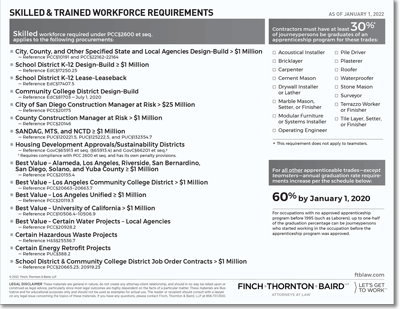
FTB_Skilled & Trained Workplace Requirements (chart).
Back To Top